







While graphic organizers are commonly associated with subjects like ELA and science, they’re also powerful tools for helping students organize their thinking in math. Graphic organizers can help make complex mathematical ideas easier to understand. That’s why we’ve collected a range of free printable math graphic organizers you can start using at any time in your classroom.
What is a graphic organizer in math?
A math graphic organizer is a visual tool that students can use to organize and structure information and concepts. Just like graphic organizers for reading, math graphic organizers come in all shapes and sizes. Math graphic organizers can help students break down problems into manageable chunks, develop their vocabulary, and so much more.
Math graphic organizers can also include visual models that are tied to math concepts like fractions and place value, helping to not only organize information but also connect to specific problems and lessons.
Benefits of graphic organizers for math
Math learning already involves many graphic representations such as bar models, area models, and fraction models, so it’s a natural fit to use graphic organizers to help students assemble their thoughts in math class. Graphic organizers also:
- Help students make complex math problems easier to understand through visual representation
- Support problem-solving by breaking down math problems into manageable steps
- Improve organization by providing structure for mathematical thinking
- Accommodate a variety of learners, including students with learning differences and multilingual learners, by reducing reliance on language alone
Types of graphic organizers for math
Below are math graphic organizers sorted by topic and purpose. We’ve also included math visual models and anchor charts.
Vocabulary/concepts
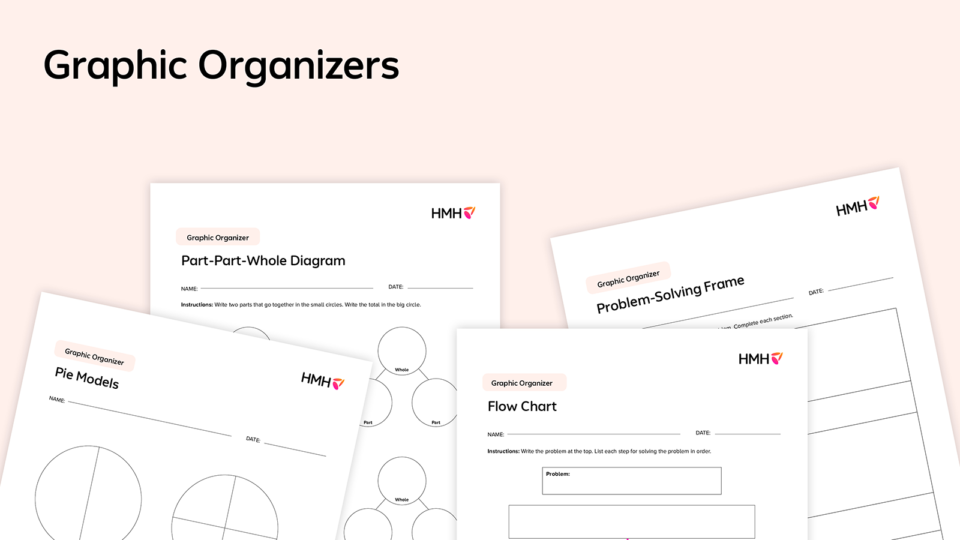
Frayer Model: Helps students learn vocabulary, using a 4-square format with sections for definition, facts/characteristics, examples, and non-examples
Word map: Includes a central term with branches for definition, visual representations, related words, and sentence
Problem-solving
Problem-solving frame: Guides students through solving word problems by using the following frame: what I know, what I need to find, my plan, solve, check, and my answer
Flow chart: Provides space for step-by-step reasoning in a flow chart format to support problem-solving
T-chart: Helps students compare two problem-solving strategies or methods
Extended response
RACE organizer: Helps students answer questions that require citing evidence (or showing their work) using the following sections: restate, answer, cite evidence (show work), and explain
Three-column organizer: Helps students organize their ideas with the following sections: my solution, how I solved it, and my reasoning
Math visual models
Visual models in mathematics can help students develop understanding of specific types of math concepts, such as fractions or percentages.
Part-part-whole diagram: Shows not only how two smaller “parts” combine to make a larger “whole” but also how having a whole and one part can help to find the missing part, helping students visualize operations like addition and subtraction
Pie model: Shows parts-to-whole relationships using a circular shape divided into slices and can be used to model fractions and percents
Math graphic organizer example templates
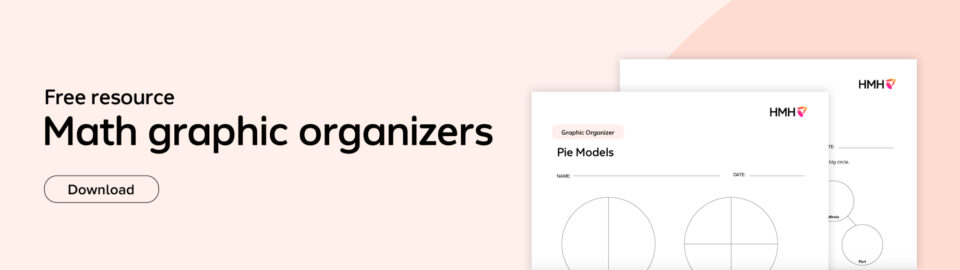
Download all the math graphic organizer templates in the PDF below.
Math anchor charts
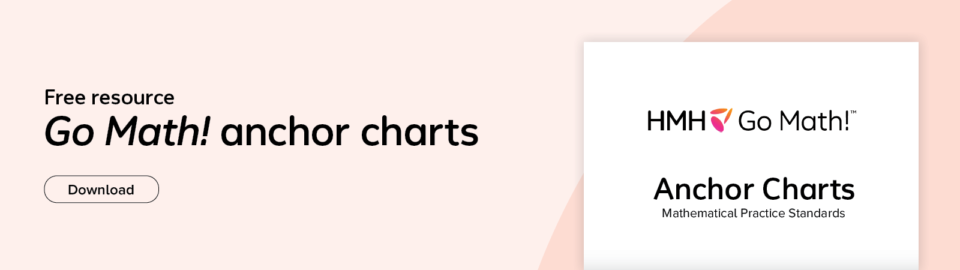
One type of graphic organizer that can support teachers of all subjects is an anchor chart, or a visual reference that students can use to direct their thinking. The anchor charts below are especially helpful in supporting math talk, as the questions can be used to facilitate discourse. Download the math anchor charts from Go Math.
Using graphic organizers in math
Start building or add to your collection by selecting one or two graphic organizers for math that align with your current needs. Here are some tips to support you and your students:
- Model: If students feel stuck while using graphic organizers, model how to use them and encourage students to help one another as they practice.
- Display examples: Post filled-in graphic organizers as anchor charts for students to reference.
- Differentiate based on readiness: For students who need more support, consider providing partially filled-in organizers. Students who don’t need that scaffold can start with blank versions.
- Let students choose: Give students the chance to select the graphic organizers that work best for them for different tasks.
Are we missing any essential blank graphic organizers for math? Share them with us via email at shaped@hmhco.com or reach out on Instagram.
***
Do you teach another subject? Check out our full list of free graphic organizer templates.
Grow student confidence in mathematics with Into Math, our core math solution for Grades K–Algebra 1.
Get our FREE guide “Optimizing the Math Classroom: 6 Best Practices.”