






There is no single way to teach math. There are so many factors, like the topics being taught, the teacher’s background, and of course, who the students are, along with what interests, knowledge, and experiences they bring into the classroom. Despite that, there are still best practices and effective strategies that teachers can consider during their planning and instruction.
This article discusses some of these high-level teaching strategies for math teachers that can work across different grades and lessons. They are ideas that have rich evidence bases and many teachers swear by. However, how to conduct your classroom ultimately rests on your judgment and—critically—your students. Some strategies, like “differentiate instruction” aren’t limited to math and can be adapted to any subject. Others, like “use number line representations,” are specific to math but won’t necessarily work in every lesson. In every case, these strategies serve as tips or reminders of how to make classroom math instruction as successful as possible.
Strategy 1: Differentiate instruction
No two students are alike. Obviously. Classrooms are mosaics of backgrounds, experiences, and languages, and students can be as different in personality as they are in math performance. One strategy that can be used across virtually every standard is to differentiate instruction, or in other words, tailor instruction to different learning needs and readiness levels so that all students can find an entry point to on–grade level content.
Differentiated instruction is a well-established approach to teaching, with research showing “positive effects of differentiated instruction on student achievement.” Teachers can try different tactics to this approach, in general trying to plan instruction so that students are afforded some agency in what tasks to do and/or how to do them. In our article on differentiated math instruction, we provide a range of ideas, including the ones below:
- Math centers: Break the classroom up into small groups and then provide each group with an activity that scaffolds or extends understanding of the current focus of whole-class instruction. The groups should be formed strategically with the tasks customized to each group.
- Math journals: Having students keep a math journal means they’re practicing literacy skills within math class. It builds in a way for teachers to identify students’ depth of understanding and comes with the benefit of students being able to reread earlier entries to see how their mathematical thinking has changed.
- Digital practice: There are a variety of digital tools, such as Waggle, that are designed to adjust instruction automatically, based on where students need the most support.
Strategy 2: Choice boards
Our article on the benefits of personalized learning gives some background on what it means to personalize instruction for every student, along with tips for doing so. Fully personalizing a classroom can be a daunting task, especially for large classes with wide gaps in math proficiency.
One relatively accessible way to personalize student learning is with a choice board. This is a menu of activities that can be used to show knowledge of a skill or practice in different ways or at a different pace. While students choose which activity on the board to complete, teachers are also afforded a lot of flexibility regarding what goes on the choice boards and can focus it all on one standard, for example, or relate to multiple standards for students to fill out at their own pace.
In our article on math choice boards for elementary school, we provide a selection of choice boards for grades K–5 that are specifically focused on geometry skills, along with a blank choice board to fill out however needed.

Strategy 3: Small-group instruction
Small-group instruction is a type of teacher-led instruction where a teacher gives a lesson to a small group of two to six students. These lessons can range from a few minutes to an entire class period. It is a critical part of tiered instruction, as it allows the teacher to focus on a single skill with just the students who need the dedicated support.
Small-group instruction occurs at all tiers of an RTI model and is perhaps most closely associated with giving targeted Tier 2 support to a small group of students not responding to Tier 1 instruction. A major challenge of implementation is needing to determine worthwhile activities for the rest of the class during small-group instruction. In our article on math small-group instructional strategies, we offer tips for including the entire class.
Regardless of the math topic, small-group instruction can be a powerful tool for teachers to provide targeted support. Because students have fewer peers listening and the teacher has fewer students to attend to, it can be an environment where students are more willing to actively participate and receive more immediate feedback.
Strategy 4: Connect math to other disciplines
One of the most common questions in math classes everywhere is, “When will I use this?” Try to preempt the question by showing how math can be connected to practically anything! For the most impactful examples, connect math to the topics your students are personally interested in. There are a variety of articles across our blog to help get you started:
- Teaching Math Through Theater: Connect math to theater concepts like stage sight lines, lighting specifications, and scale model drawings.
- Math at The Met: Using art from the Metropolitan Museum of Art in New York City (“The Met”), connect math to art with concepts like number representations and spatial dimensions.
- Math Meets Sports: Connect math to sports with concepts like measuring distance and graphing and analyzing data.
- Math Meets Entrepreneurship: Connect math to business with concepts like tracking expenses and valuating companies.
Our Math at Work page contains even more examples, including fashion, the culinary arts, and homebuilding.
Math can even be connected to other disciplines without varying how the lesson is taught. Look for ways to construct examples that tap into what students care about (for example, when teaching fractions, replace pizzas and pies with students’ favorite foods) or to modify word problems to suit a specific classroom (for example, if a student named Juan collects soccer cards, replace “Bob has 3 apples” with “Juan has 3 soccer cards”). Even small surface-level changes like these can cause big improvements to student motivation.
Strategy 5: Gamified instruction
Is engagement in the math classroom waning? Turn the lesson into a game! Not all lessons should be games, of course, but many can be. There is a lot to learn from games and how they naturally get people to stay on task for hours at a time and persist in the face of failure. When the objectives of a game align to the objectives of a lesson, there is the potential for fun and compelling learning.
Critically, gamifying instruction is not exactly the same thing as repurposing instruction as a game. Games can include many features, such as points, avatars, leaderboards, and quests, with different games having different features. Even introducing one or two features like those can help some students feel more engaged. On a more abstract level, games have elements such as eliciting creativity or driving action, and teachers can model these elements in lessons without there needing to be complicated rules or game winners.
This idea of making instruction game-like without necessarily turning it into a game is called gamification and can be implemented in countless ways. It is a powerful educational tool, too. One 2023 meta-analysis found an “overall significant large effect size” when looking across dozens of studies and thousands of students. Consider what aspects of gaming might be helpful in the lesson you’re teaching and try those. It can be as simple as having students draw an avatar for an upcoming word problem before beginning the problem.
Strategy 6: Use number line representations
Using a variety of models and representations is simply good math teaching. It helps students form mental models and connect ideas. There is one model that is perhaps uniquely powerful across mathematics: the number line. It is unique in how flexibly it represents different numbers of all types and a valuable representation to always keep in mind when a student feels stuck.
The number line can frequently be called upon to model a situation or help to solve a problem. One topic where it has special importance is fractions. Plenty of students (and adults!) struggle with fractions, yet it is not a topic that teachers can ignore. Research suggests that children’s ability to solve problems with fractions correlates with overall math achievement, with evidence that the the number line is an especially effective tool for teaching fractions.
Strategy 7: Use math language routines
Teachers employ all sorts of routines in their classrooms. They are often used to manage a classroom, such as a routine that has students lining up in an orderly way before leaving the classroom getting students to be silent after hearing a few repeated handclaps. There are also routines like “turn and talk” or “think-pair-share,” which are used as part of learning a lesson.
Fitting instructional routines around language into a math classroom might, at first glance, seem mismatched. However, this can be a powerful way to drive a lesson forward. To start, multilingual learners benefit from focusing on the language of math, as sometimes they are stuck not because of issues with the math concepts but because of challenges with the language. Moreover, developing language-based routines in the classroom can help every learner, multilingual or not. Language is a core part of math—as anyone who has stumbled through a word problem understands. Language is needed for problems to be described, students to ask questions, and teachers to explain concepts.
In our article on math language routines, we offer a few different routines that can be tried out in many different settings, like the ones below that come from Stanford University’s SCALE Initiative:
- Three Reads: Students read a word problem three times, focusing in on a different aspect of the language with each read.
- Compare and Connect: Students solve a problem in two different ways and then compare their approaches.
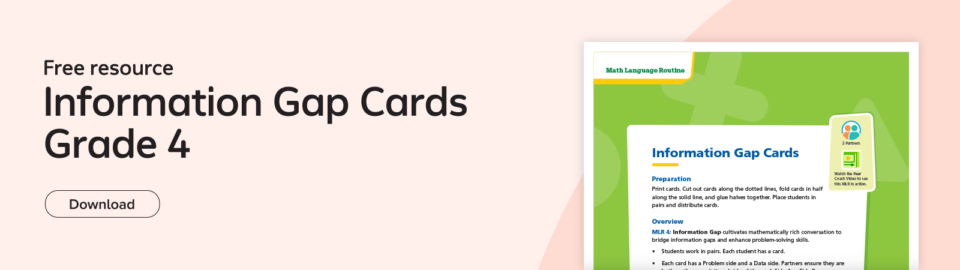
- Information Gap: Students look at two premade information gap cards that together solve but a problem but individually don’t.
- Critique, Correct, and Clarify: Teachers present a partially correct solution, with students trying to identify the error.
These routines, along with several others, are supported throughout Into Math, with materials for implementing them provided across many lessons.
Strategy 8: Facilitate student discourse
Discourse in math refers to getting students talking about math. One key benefit of doing this is it gets students breaking down their reasoning, deepening understanding and exposing misconceptions. Also, similar to math language routines, discourse gets students connecting math to language and doing so with precision.
One way to categorize student discourse is to break it down into two types:
- Whole-group discourse: This type of discourse is teacher-led and is often between the teacher and students instead of being among students.
- Small-group discourse: This type of discourse is teacher facilitated, with the teacher walking around the room, listening to students, and only giving feedback selectively.
Ideally, a lesson includes as much small-group discourse as possible, where teachers are paying attention to what different groups are talking about and how they discuss math. This helps teachers gather formative feedback to inform what to teach next and what errors students seem to make.
To make sure the conversation is productive and on-topic, the teacher will need to facilitate the student conversations in some way. In our article on mathematical discourse in the classroom, we explore some of the ways to do this, such as by revoicing, where the teacher repeats what the student says and asks if it was stated correctly, or by adding on, where the teacher adds a series of open-ended questions to how a student starts to solve a problem that work towards a full, complex explanation for a solution.
Strategy 9: Promote being a math person
This strategy deals with students’ metacognition rather than being attached to any specific math standard. It stems from how many students see people divided into two camps: “math people,” who seem to get and enjoy doing math, and “non-math people,” for whom math doesn’t seem to click. Most troublingly, plenty of students then do not see themselves as “math people.”
This fundamental myth can have far-reaching consequences, and it is important for teachers to be mindful of the language they use when discussing math and when talking with students who express doubt in their abilities. A challenge is that many educators may not think of themselves as "math people,” and so it is likewise important for them to consider their own mindsets about math, too. Early in their math educations, students who don’t see themselves as “math people” show less effort and are quicker to give up. The problem compounds over years, and then later in their educations, they feel hopelessly behind and don’t think they’re even capable of learning grade-level math.
Teachers can help by nipping this myth in the bud whenever possible. Encourage students to see themselves as “math people” even through struggles and help them build perseverance with the subject. Always be on the lookout for examples of creative solutions and effortful attempts that reveal how all students are capable of understanding mathematical ideas and solving difficult problems.
Mathematics teaching methods and techniques
In 2014, the National Council of Teachers of Mathematics, or NCTM, published eight Effective Teaching Practices in their seminal work Principles to Actions: Ensuring Mathematical Success for All. Those practices offer a research-based framework for how to approach teaching math and, importantly, speak to how many different lenses there are with which to think about teaching math. Although they are not explored in this article, there is a Heinemann blog post that details them, and the full list is given below for comparison’s sake.
- Establish mathematics goals to focus learning
- Implement tasks that promote reasoning and problem solving
- Use and connect mathematical representations
- Facilitate meaningful mathematical discourse
- Pose purposeful questions
- Build procedural fluency from conceptual understanding
- Support productive struggle in learning mathematics
- Elicit and use evidence of student thinking
In 2022, NCTM President Trena Wilkerson wrote an article urging teachers to select just one of those practices to focus on. This article offers a different set of math instructional strategies (with some overlap); yet, all of the strategies in this article can hopefully spark ideas that can work for you in your classroom. Simply choosing one to focus on is a great start. If you can find the right ways of teaching mathematics that maximize learning for your students, you’ll be setting them up for a lifetime of math achievement.
***
Looking to grow student confidence in mathematics? Explore HMH Into Math, our core math solution for Grades K–Algebra 1
Get our FREE guide “Optimizing the Math Classroom: 6 Best Practices.”