
-
Core Curriculum



SCIENCE OF READING CURRICULUM
Systematic, explicit K-12 reading and writing instruction
Grounded in reading research, guided by a structured literacy approach
The science of reading draws on decades of interdisciplinary research to explain how students learn to read and write. Our science of reading curriculum applies this research through explicit, systematic literacy instruction and a structured literacy approach that develops essential literacy skills over time. From foundational skills to advanced reading comprehension, writing, and higher-order thinking, HMH literacy programs support every stage of literacy development across Grades K–12.
Reading success pillars
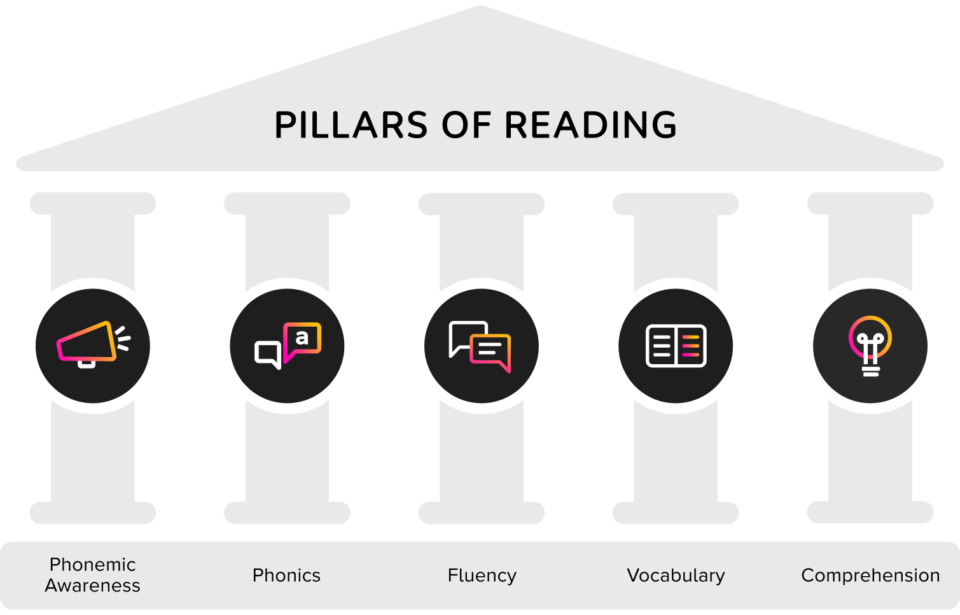
HMH programs build on the five pillars of literacy—phonemic awareness, phonics, fluency, vocabulary, and comprehension. Reflecting the latest research, our programs also integrate background knowledge, writing, and language development.
An effective gradual release model
Our K–12 core instruction, rated “All Green” by EdReports, builds foundational reading skills and comprehension, moving from simple to complex through a systematic scope and sequence.

The best texts for building knowledge
Texts at the heart of our instruction emphasize cross-curricular content throughout a student’s literacy journey, building background knowledge and vocabulary across topics and grade levels.

Research-based writing instruction
Students demonstrate comprehension and mastery through daily scaffolded writing practice, receiving feedback that guides them throughout the writing process.

With the data, not only from state assessments, but from the curriculum and benchmarks that are provided by HMH, we’re able to understand the story of a child, the progress that is needed to help a child build and achieve success.
Superintendent, Blackfoot School District, ID
Explore our science of reading programs
HMH programs are grounded in scientifically based reading instruction designed to reach every learner. Select your grade level to get started.
All Products
Amira Learning
HMH Into Literature
HMH Into Reading
HMH ¡Arriba la Lectura!
Read 180
Waggle
Writable
Amira Learning® for Grades PreK–8 provides effective 1:1 reading tutoring that doubles student reading growth, a reading fluency assessment, and dyslexia risk screening in English and Spanish—from anywhere.
HMH Into Literature® for Grades 6–12 equips students with the reading, writing, speaking, and listening skills required for success in tomorrow's world.
HMH Into Reading® for Grades K–6 addresses all areas of early literacy with an evidence-based scope and sequence to develop fluent, automatic readers.
HMH ¡Arriba la Lectura!™ is a comprehensive K–6 Spanish literacy program. When paired with HMH Into Reading, the programs provide a complete Spanish-English solution for biliteracy and dual-language classrooms.

Built on over 25 years of research and grounded in the science of reading, Read 180® is an intensive reading intervention program that delivers a comprehensive path from phonics to fluency to grade-level proficiency for students in Grades 3–12 who are 1 or more years below grade level.
With NWEA® MAP® Growth™ integrated, educators can accurately place students and track progress over time. Whether supporting multilingual learners, students with disabilities, or those with foundational gaps, Read 180 provides adaptive technology, engaging content, and teacher-led instruction—all in a dedicated classroom setting that accelerates growth and builds confident, capable readers.
Waggle®, for ELA and math grades K–8, goes beyond adaptive learning to provide personalized practice and instruction. With its skill-based AI engine, Waggle offers real-time assessment of knowledge, enabling teachers to support the needs of all learners effectively.
Writable® for Grades 3–12 delivers scaffolded writing practice, teacher and peer feedback tools, and AI-powered support to help educators tailor instruction to diverse student needs, culminating in purposeful revision that grows engaged and successful writers.
Grades K–2
Amira Learning® for Grades PreK–8 provides effective 1:1 reading tutoring that doubles student reading growth, a reading fluency assessment, and dyslexia risk screening in English and Spanish—from anywhere.
HMH Into Reading® for Grades K–6 addresses all areas of early literacy with an evidence-based scope and sequence to develop fluent, automatic readers.
HMH ¡Arriba la Lectura!™ is a comprehensive K–6 Spanish literacy program. When paired with HMH Into Reading, the programs provide a complete Spanish-English solution for biliteracy and dual-language classrooms.
Waggle®, for ELA and math grades K–8, goes beyond adaptive learning to provide personalized practice and instruction. With its skill-based AI engine, Waggle offers real-time assessment of knowledge, enabling teachers to support the needs of all learners effectively.
Grades 3–6
Amira Learning® for Grades PreK–8 provides effective 1:1 reading tutoring that doubles student reading growth, a reading fluency assessment, and dyslexia risk screening in English and Spanish—from anywhere.
HMH Into Reading® for Grades K–6 addresses all areas of early literacy with an evidence-based scope and sequence to develop fluent, automatic readers.
HMH ¡Arriba la Lectura!™ is a comprehensive K–6 Spanish literacy program. When paired with HMH Into Reading, the programs provide a complete Spanish-English solution for biliteracy and dual-language classrooms.
Built on over 25 years of research and grounded in the science of reading, Read 180® is an intensive reading intervention program that delivers a comprehensive path from phonics to fluency to grade-level proficiency for students in Grades 3–12 who are 1 or more years below grade level.
With NWEA® MAP® Growth™ integrated, educators can accurately place students and track progress over time. Whether supporting multilingual learners, students with disabilities, or those with foundational gaps, Read 180 provides adaptive technology, engaging content, and teacher-led instruction—all in a dedicated classroom setting that accelerates growth and builds confident, capable readers.
Waggle®, for ELA and math grades K–8, goes beyond adaptive learning to provide personalized practice and instruction. With its skill-based AI engine, Waggle offers real-time assessment of knowledge, enabling teachers to support the needs of all learners effectively.
Writable® for Grades 3–12 delivers scaffolded writing practice, teacher and peer feedback tools, and AI-powered support to help educators tailor instruction to diverse student needs, culminating in purposeful revision that grows engaged and successful writers.
Grades 6–8
Amira Learning® for Grades PreK–8 provides effective 1:1 reading tutoring that doubles student reading growth, a reading fluency assessment, and dyslexia risk screening in English and Spanish—from anywhere.
HMH Into Literature® for Grades 6–12 equips students with the reading, writing, speaking, and listening skills required for success in tomorrow's world.
Built on over 25 years of research and grounded in the science of reading, Read 180® is an intensive reading intervention program that delivers a comprehensive path from phonics to fluency to grade-level proficiency for students in Grades 3–12 who are 1 or more years below grade level.
With NWEA® MAP® Growth™ integrated, educators can accurately place students and track progress over time. Whether supporting multilingual learners, students with disabilities, or those with foundational gaps, Read 180 provides adaptive technology, engaging content, and teacher-led instruction—all in a dedicated classroom setting that accelerates growth and builds confident, capable readers.
Waggle®, for ELA and math grades K–8, goes beyond adaptive learning to provide personalized practice and instruction. With its skill-based AI engine, Waggle offers real-time assessment of knowledge, enabling teachers to support the needs of all learners effectively.
Writable® for Grades 3–12 delivers scaffolded writing practice, teacher and peer feedback tools, and AI-powered support to help educators tailor instruction to diverse student needs, culminating in purposeful revision that grows engaged and successful writers.
Grades 9–12
HMH Into Literature® for Grades 6–12 equips students with the reading, writing, speaking, and listening skills required for success in tomorrow's world.
Built on over 25 years of research and grounded in the science of reading, Read 180® is an intensive reading intervention program that delivers a comprehensive path from phonics to fluency to grade-level proficiency for students in Grades 3–12 who are 1 or more years below grade level.
With NWEA® MAP® Growth™ integrated, educators can accurately place students and track progress over time. Whether supporting multilingual learners, students with disabilities, or those with foundational gaps, Read 180 provides adaptive technology, engaging content, and teacher-led instruction—all in a dedicated classroom setting that accelerates growth and builds confident, capable readers.
Writable® for Grades 3–12 delivers scaffolded writing practice, teacher and peer feedback tools, and AI-powered support to help educators tailor instruction to diverse student needs, culminating in purposeful revision that grows engaged and successful writers.
A school district’s literacy success story
The Blackfoot School District in Idaho saw significant reading gains in just one school year, using HMH programs that are aligned to the science of reading.
Apply crucial reading success pillars
The science of reading and writing has continued to expand our understanding of the essential elements of reading instruction. HMH is at the forefront of this evolution, delivering solutions to help districts address the needs of today’s students.
ESSA-strong 1:1 reading tutoring
Amira provides personalized 1:1 reading tutoring with precise micro-interventions rooted in the science of reading. Discover:
- Automated oral reading fluency assessment
- Dyslexia risk screening
- Quick, time-saving implementation

The most effective reading intervention
Read 180 is a science of reading intervention program that helps students who are more than one year behind achieve grade-level proficiency. Teachers and students benefit from:
- Comprehensive literacy approach
- Personalized, adaptive instruction and practice
- Up to two years of reading growth in one year

Personalized teacher support
HMH provides science of reading professional development from foundations to fluency, ensuring teachers have the tools they need to build proficient readers. Teacher Success Pathways and Teacher’s Corner® provide:
- Implementation support for success in the first 30 days
- Personalized pacing and topics
- Year-round, on-demand learning

Personalized Professional Development
HMH partners with schools and districts to foster a culture of growth through relevant, ongoing professional learning for every educator. Connect with us for guided implementation support for your programs, year-round instructional coaching through HMH’s Coachly™ and courses, and shoulder-to-shoulder partnership for leaders from Center for Model Schools.

Frequently asked questions
-
How does reading research inform HMH literacy programs?
HMH literacy programs are informed by decades of research on how students learn to read and are designed around explicit, systematic instruction and a coherent progression of literacy skills. Instruction moves from simpler to more complex skills, building on previously taught skills through teacher modeling, guided practice, cumulative review, feedback, and opportunities to apply learning in reading and writing.
-
How do HMH literacy programs align with the science of reading?
HMH literacy programs align with the science of reading by applying evidence about how students develop word recognition and language comprehension. HMH’s early literacy and intervention programs explicitly address the five pillars of reading—phonemic awareness, phonics, fluency, vocabulary, and comprehension. Secondary core instruction emphasizes increasingly complex text, academic vocabulary, knowledge building, analysis, and writing. Across the K–12 continuum, skills progress from foundational literacy in the early grades to advanced reading comprehension and higher-order thinking in the secondary grades, supporting literacy development over time.
-
How do HMH literacy programs use a structured literacy approach?
HMH literacy programs use a structured literacy approach by providing explicit, systematic, cumulative, and diagnostic instruction that builds literacy skills in a planned progression from simple to complex. Students develop an understanding of language at multiple levels, including phonological awareness, sound-symbol relationships, syllables, morphology, syntax, and semantics. Ongoing assessment and progress monitoring help educators determine when to reteach, provide additional practice, or extend learning.
-
How do HMH literacy programs teach foundational literacy skills?
HMH literacy programs teach foundational literacy skills through a sequenced progression of phonological and phonemic awareness, phonics, decoding and encoding, spelling, and fluency. Students build and reinforce these skills through direct instruction and focused practice and apply them in connected reading and writing. As students advance, word study progresses to multisyllabic words, morphology, syntax, and Greek and Latin roots, extending foundational learning to support increasingly complex reading and writing.
-
How do HMH literacy programs develop language comprehension through vocabulary and knowledge building?
HMH literacy programs develop language comprehension through explicit vocabulary instruction and knowledge building with authentic literary and informational texts. Students build background and topic knowledge as they read connected texts, explore ideas across disciplines, discuss what they read, and use new vocabulary in meaningful contexts. Making connections across topics expands the vocabulary and knowledge students can draw on to deepen comprehension.
-
How do HMH literacy programs integrate writing into science of reading instruction?
HMH literacy programs integrate reading and writing based on research showing that developing these skills together strengthens vocabulary, knowledge, comprehension, and overall literacy. Students write in response to literary and informational texts while receiving explicit instruction in the writing process, grammar, conventions, and writing craft. Reading and writing experiences give students opportunities to use text evidence, synthesize knowledge, and communicate their understanding across genres.
-
How does science of reading instruction change as students progress from elementary to secondary grades?
Instruction aligned with the science of reading progresses from building foundational literacy skills in the elementary grades to developing advanced comprehension and higher-order thinking in the secondary grades. HMH Into Reading for Grades K–6 provides systematic instruction in foundational reading and writing skills while strengthening language comprehension and knowledge through authentic texts. HMH Into Literature for Grades 6–12 extends that foundation as students analyze increasingly complex texts, expand academic vocabulary and knowledge, and move from guided practice toward greater independence. This K–12 progression connects foundational skills with advanced reading, writing, and thinking.
-
How do HMH literacy programs support differentiation while aligning with the science of reading?
HMH literacy programs support differentiation by combining evidence-based literacy instruction with assessment data and flexible resources that help educators respond to individual learning needs. Teachers can use formative checks to identify areas for support, form flexible groups, and provide scaffolded or extended practice through teacher-led small-group instruction. For students who need intensive intervention, Read 180 provides a dedicated, teacher-led intervention model for Grades 3–12, while Read 180 Flex provides targeted reading intervention within the grade-level classroom. HMH core literacy programs can also be paired with Amira, Waggle, and Writable to provide personalized reading tutoring, adaptive practice, and scaffolded writing support.
-
How do HMH literacy solutions provide reading intervention aligned with the science of reading?
HMH literacy solutions deliver research-based reading intervention grounded in the science of reading for students who need additional support to meet grade-level expectations. Built on more than 25 years of research and proven results, Read 180 provides intensive, teacher-led reading intervention for students in Grades 3–12, with explicit and systematic instruction in phonemic awareness, phonics, fluency, vocabulary, and writing, supported by ongoing assessment and targeted practice. Read 180 Flex extends this approach within the grade-level classroom, providing targeted reading intervention for students performing below grade level. Amira complements instruction with 1:1 reading tutoring and science of reading-based micro-interventions that provide additional practice and support.
-
What assessment and progress-monitoring tools support HMH science of reading instruction?
HMH literacy programs support science of reading instruction with assessment and progress-monitoring tools that help educators identify specific skill needs, track growth, and use data to inform instruction and intervention. Core literacy programs use embedded assessments and formative checks to inform instructional decisions, while Read 180 incorporates ongoing assessment to personalize intervention and monitor progress. Amira provides oral reading fluency assessment and dyslexia risk screening; Waggle provides real-time insights into skills mastery; and Writable provides writing assessment and rubric-aligned scoring.
-
What professional learning does HMH provide to help educators apply the science of reading?
HMH provides professional learning that helps teachers and leaders deepen their understanding of science of reading research and apply evidence-based literacy practices in classrooms and schools. Onsite and virtual courses, workshops, and instructional coaching cover key areas of literacy development, from foundational skills and language comprehension to writing, assessment, and intervention. Educators can also access embedded, on-demand professional learning through HMH Ed to support ongoing implementation. Educators gain practical routines and resources for putting science of reading research into practice and sustaining effective literacy instruction over time.
See how our science of reading programs can help students thrive.
Insights and resources

One of the first skills developing readers need to master is phonological awareness. In this article, we will dig into what phonological awareness is and the importance of referencing it for reading instruction.

Based in the science of reading, sound walls in the classroom help educators reinforce the importance of explicitly teaching the skills of letter-sound correspondence.

Get book recommendations to learn more about the science of reading and see how children learn to read and develop as strategic readers.
Webinar
Presented by Dr. Nathan Clemens, Associate Professor in the Department of Special Education at The University of Texas.
- Report Type: Professional Paper
- Report Type: Professional Paper
- Report Type: Professional Paper
See how our science of reading programs can help students thrive.
Contact us about Science of Reading
Please note: If you have a question about billing, an order, an invoice, or just need technical support, please contact support.
Thank You for contacting us about Science of Reading! Please check your email for next steps.
Thank You for contacting us about Science of Reading! Please check your email for next steps.