







Summary
Teaching phonological awareness skills helps students build the sound-based skills needed for decoding, spelling, and literacy development.
Key takeaways
- Students develop phonological awareness through increasingly complex skills, progressing from words and syllables to individual phonemes.
- Activities such as rhyming, syllable segmentation, blending, and sound manipulation help strengthen foundational literacy skills.
- Strong phonological awareness supports later decoding, spelling, and reading fluency by helping students understand how spoken words are organized.
Learning to read and write begins long before students ever look at or write words on a page. It starts with learning to listen by hearing the sounds in spoken language and understanding how those sounds work together.
Phonological awareness lays the foundation for reading and writing success, helping students connect spoken and written language as they build confidence and fluency. This article explores phonological awareness examples, how these skills develop, and practical ways to teach them through clear instruction and hands-on activities.
What are phonological awareness skills?
If you’ve ever heard young children playing with language, like clapping to the beat of a familiar nursery rhyme or laughing as they notice how “cat” and “hat” sound similar, you’ve seen phonological awareness in action. These moments lay the groundwork for learning to read and write.
According to Dr. Anne Cunningham and Dr. Jamie Zibulsky, phonological awareness refers to a broad set of skills involving the recognition and manipulation of the sound structure of spoken language. When teachers intentionally plan phonological awareness instruction, they help students build the early foundations that make decoding, spelling, and fluency possible.
Progression of phonological awareness skills
Phonological awareness refers to a broad set of listening skills that involve recognizing and working with sounds in spoken language. It includes noticing how words can be broken into smaller parts, such as syllables and individual sounds, and understanding how those parts can change to create new words.
Phonological awareness is often described as an umbrella term that includes a range of sound-based skills, from the simplest to the most complex. These include:
- Word awareness: Hearing individual words in a sentence
- Syllable awareness: Breaking words into syllables or counting them aloud
- Onset and rime awareness: Recognizing the initial sound in a word and the remaining part that follows (for example, /s/ and it in sit)
- Phonemic awareness: Identifying and manipulating individual sounds, or phonemes, in words; phonemic awareness specifically deals with the smallest units of sound within words
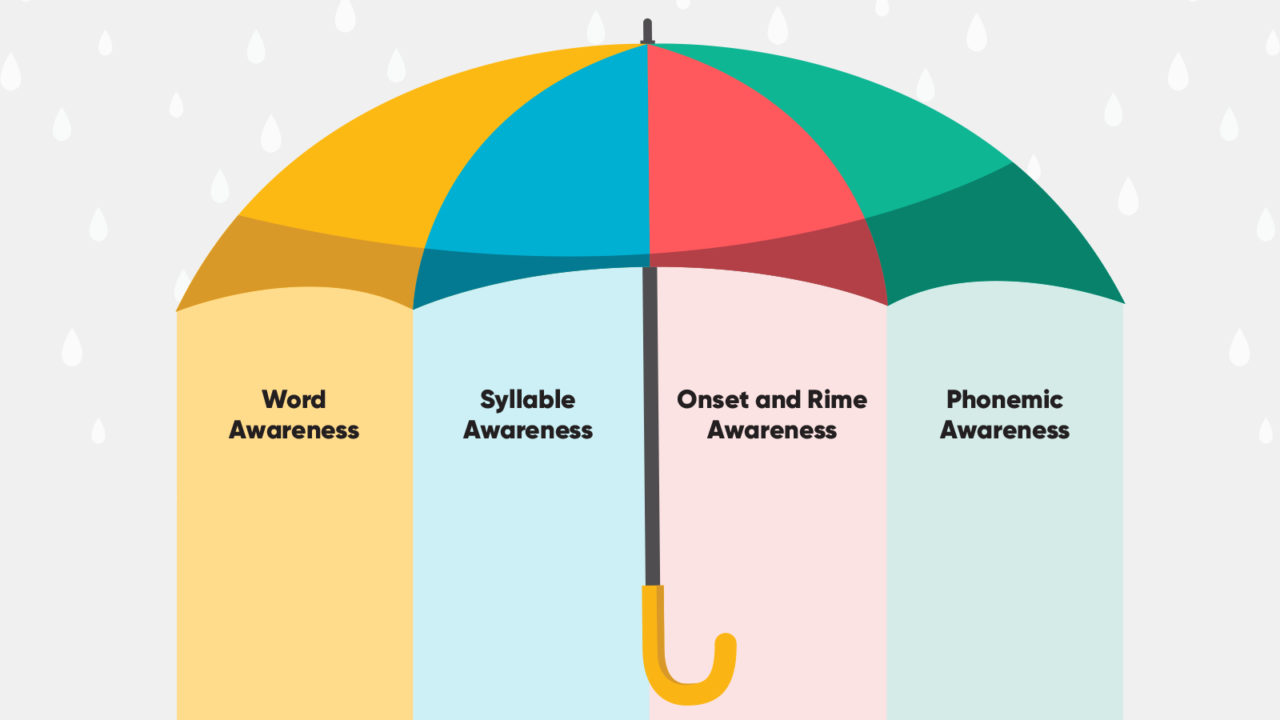
Each of these skills builds upon the others to help students develop a strong foundation for reading and spelling. The progression of phonological awareness skills typically moves from less complicated tasks, like identifying rhyming words or clapping out syllables, to more complex ones, such as isolating, blending, and segmenting individual phonemes. Understanding this developmental sequence helps teachers provide instruction that meets students where they are and gradually supports them toward mastery.
What is the importance of phonological awareness instruction?
The importance of phonological awareness begins with recognizing that students can’t fully connect spoken and written language until they understand that words are made up of individual sounds. Research has consistently shown that the lack of phonological awareness, such as having trouble hearing rhymes, clapping out syllables, or identifying the first sound in a word like dog, is a key contributor to reading difficulties, including dyslexia. These early gaps can make it harder to connect spoken and written language later on.
Here are key reasons why phonological awareness instruction is essential:
- It forms the bridge between spoken language and written words. Without understanding the sound structure of words, students may not grasp how letters represent those sounds.
- Strong phonological awareness is a reliable predictor of reading success. Students with a solid understanding of skills in this area tend to become stronger readers.
- Teaching these skills explicitly can reduce the likelihood of persistent reading difficulties and support students who are at risk of falling below grade-level proficiency in reading.
When we plan targeted instruction around phonological awareness, we shift from hoping students will pick it up to proactively building the foundational skills that support fluent reading and confident writing.
Tips for teaching phonological awareness skills
Effective instruction starts with understanding that teaching phonological awareness is most successful when it’s intentional and consistent. Students benefit when teachers move through a clear sequence of skills, provide multiple practice opportunities, and emphasize spoken language while also connecting it to print in meaningful ways.
Phonological awareness teaching strategies
Below are phonological awareness teaching strategies that can help keep instruction both intentional and responsive:
- Start with listening and language play: Begin with oral activities that help students tune their ears to the sounds of language. Songs, rhymes, and word games can help students become aware that words are made up of smaller sound units.
- Use multisensory methods: Combine listening, movement, and visuals to integrate multiple senses into the learning experience.
- Move from simple to complex skills: Teach one skill at a time, grouping students who are working on the same level or skill. Begin with broader concepts, such as recognizing words and syllables, before progressing to individual phonemes, which can be harder for students to identify. This targeted approach helps ensure students receive instruction that matches their current stage of development.
- Use modeling and repetition: Clearly demonstrate each task, whether it’s clapping syllables or identifying a beginning sound, before students try it independently. Consistent repetition helps reinforce understanding and build automaticity over time.
- Integrate short, frequent lessons: Phonological awareness instruction is most effective in brief, focused segments. A few minutes each day can make a lasting impact when lessons are targeted and engaging.
- Monitor progress and adjust instruction: Regularly assess students’ understanding through observation and quick checks. Use this information to determine who needs additional support or review before introducing new skills.
When teachers follow a gradual, intentional process, they make teaching phonological awareness more effective for students. These early listening and sound recognition skills help students continue to develop as readers.
Activities to teach phonological awareness
When it comes to phonological awareness activities, the goal is to invite students to listen closely, play with sounds, and discover how words work. Research shows that phonological awareness instruction is most effective when paired with explicit teaching of letters and their corresponding sounds. It’s important to give students hands-on ways to explore those sounds through language and play. These are examples of phonological awareness activities that move from simpler to more complex tasks:
- Syllable stomp: Say a word and have students stomp or jump once for each syllable. Afterward, ask them to echo the word and stomp or jump again.
- Rhyme match: Give students pairs of picture cards that rhyme (bat/cat, log/frog). Mix them up and have students find and say the rhyming matches aloud.
- Sound-sorting basket: Fill a basket with small classroom or household objects (for example, button, block, spoon, sock, car, cup). Have students take turns naming each item and sorting them into groups that start with the same sound. Say each word together to emphasize the beginning sound.
- Beginning sound match: Give students picture cards and have them find two that start with the same sound. Say each pair aloud together (sun and sock, ball and bat) to reinforce the sound connection.
- Onset-rime slides: Write a few rimes (-at, -ip, -et) on cards. Write different beginning sounds, or onsets, on other cards. Have students slide the cards together and say the new words they make (mat, hat, sat; sip, hip, lip). You can differentiate by using onsets with single letters or moving to more complex sounds like digraphs (ch, th) and blends (st, pl).
- Elkonin boxes (sound boxes): Have students listen to a word (for example, cat) and move a letter magnet or token into boxes for each phoneme [cat, for example, uses three boxes (/c/ /a/ /t/)].
- Blend phonemes: Say the sounds of a CVC word slowly, for example r – u – g for the word rug. Ask students to blend the sounds and say the word rug. Try other CVC words with short vowels (e.g., tap, bed).
- Segmenting phonemes: Tell students a word and then ask students to tell you the sounds they hear. For example, say bed. Students should respond /b/ (pause) /e/ (pause) /d/.
- Deleting phonemes: Tell students a word and then ask them to repeat it back without the initial phoneme. Increase the difficulty by telling students a word and then asking them to repeat it back without the final phoneme. For example, say hat, and then ask the students to say it without /h/. The students should respond /at/.
Differentiating phonological awareness instruction
Not all students develop phonological awareness skills at the same pace. Some may quickly hear and play with sounds, while others need more time and support. That’s where differentiating phonological awareness instruction becomes essential. When teaching a class of students who are all performing at different levels and need varying levels of support, these strategies for teaching phonological awareness can help to ensure that every student can build a strong foundation for reading and writing:
- Organize small groups by skill, such as isolating beginning sounds or blending phonemes. This allows you to match instruction and pacing to each group’s needs.
- Use visuals, movement, or manipulatives to make abstract sound work more concrete for students who need extra reinforcement.
- For students ready to move ahead, increase complexity by offering new challenges, like moving from syllable to phoneme work, using longer words, or exploring sounds within sentences and phrases.
- Provide frequent review of earlier skills. For students who may need additional support, ensure that they have additional modeling and guided practice to confirm their understanding, and then provide additional opportunities for practice, especially to develop students’ automaticity in applying the skills.
Differentiating phonological awareness instruction helps every student, regardless of their current proficiency level, make steady progress toward becoming an independent reader.
Building a strong foundation for reading success
Teaching phonological awareness gives students the foundation they need to become readers. With consistent practice, engaging activities, and thoughtful differentiation, every student can grow in their ability to hear and work with sounds in language.
The views expressed in this article are those of the author and do not necessarily represent those of HMH.
***
HMH core, intervention, and supplemental programs are rooted in the science of reading. Find out more about our evidence-based approach to teaching a child to read.
Be the first to read the latest from Shaped.