





Summary
Teachers use Writable alongside Into Reading and Into Literature to strengthen writing instruction, feedback, and student growth.
Key takeaways
- Integrating writing and reading instruction helps students apply literacy skills across multiple types of learning experiences.
- Timely feedback and targeted recommendations help students develop writing skills and revise with greater purpose.
- Using shared instructional resources can help streamline planning while providing a more cohesive literacy experience for students.
Teaching writing has always been a bit messy—and that’s not just okay, it’s where the magic happens. Teachers, students, and administrators alike know that the journey from a blank page to a finished piece is rarely straightforward. Brainstorming, drafting, revising, and editing are full of creative detours and unexpected discoveries.
Recently, a group of educators shared their experiences with HMH about integrating AI into their writing instruction, and the conversation was eye-opening. With the right tools that support teachers through each step, the process can become more manageable and more meaningful for students.
How Writable works with Into Reading and Into Literature
Writable® is a writing practice and feedback tool that, starting in Grade 3, supports daily instruction alongside HMH Into Reading® and HMH Into Literature®. As a supplemental program, it uses AI functionality to reinforce the writing routines already in your curriculum—helping teachers give targeted feedback, scaffold skill development, and strengthen core writing instruction.
Rethinking the writing process in today’s classroom
For many educators, the traditional writing process felt like a rigid structure. As curriculum specialist, Abbey Behnke put it, "I kind of just left it as this is the writing process: now we're all brainstorming, and then now we're all writing our draft, and then we're going to revise our draft… And I just went on this Ferris wheel over and over and over of this writing process." This structured approach often led to students producing writing that sounded more like the teacher than themselves. Individuality and unique voices were stifled, replaced by a formulaic style that mirrored the teacher’s expectations.
With Writable teachers can turn that natural “messiness” into meaningful progress, offering structure where it’s helpful while still encouraging strong student voice and creativity. Best of all, it stays aligned with the writing tasks embedded in Into Reading and Into Literature.
Strengthening core skills with Writable
Writable’s instructional design follows a Practice–Feedback–Revision cycle, supported by AI that lightens the load for prep, feedback, and grading. It doesn’t replace the core curriculum; it enhances it.
Initially, there was hesitation. "I almost felt like I was cheating myself," admitted Michiela Miller, a 5th grade teacher, echoing a common sentiment that AI is a shortcut or a crutch. There was a fear that AI would replace the teacher's role and diminish the learning experience. However, as educators began experimenting with tools like Writable, they discovered a different reality.
AI tools offered a new dimension to the writing process. Suddenly, students were receiving feedback that teachers might not have thought of, stretching their ideas in unexpected ways. "It was giving them suggestions and expanding on ideas that they had in ways that I had never done before," Behnke noted. This opened up a world of possibilities, moving beyond the teacher’s perspective and embracing a broader range of feedback.
There are other ways to use the tool, too. Teachers can assign genre-specific skills that directly connect to the unit, writing tasks in both programs. Built-in scaffolds and feedback tools support students at every proficiency level, including multilingual learners, and are available in both English and Spanish. This ensures every student has access to the skills and strategies they need to grow.
How Teachers Use Writable with Into Reading and Into Literature
Writable fits naturally into classroom routines with existing core curriculum. Common uses include:
Daily writing practice connected to an Into Reading lesson
A third-grade teacher might introduce a skill—like identifying the author’s purpose—during an Into Reading lesson. After reading the anchor text together, students open a Writable assignment that guides them through a short, written response. The platform offers sentence starters and model examples, helping emerging writers get started while giving confident writers room to expand their thinking.
Extended response writing for HMH Into Literature
In middle school, a teacher using Into Literature might assign an extended literary analysis after students finish a shared text. Writable helps students break down the task into manageable steps: planning, drafting, revising, and polishing. AI-powered feedback nudges students to clarify arguments, strengthen evidence, and refine their tone before the teacher even reads the draft. This frees up classroom time for deeper conferences and small-group work.
Targeted teacher feedback during independent writing time
During independent writing time, teachers often circulate to check in with students. With Writable, a teacher can quickly pull up multiple drafts, leave voice or text comments, or select from scaffolded suggestions. Instead of spending the evening marking papers, teachers can give bite-sized feedback in the moment and redirect their attention to conferencing with students who need more support.
Scaffolded assignments for diverse learners, including multilingual students
A fifth-grade teacher may use Writable to support multilingual learners during an opinion writing unit in Into Reading. Students can draft in English or Spanish, receive vocabulary prompts, or access sentence frames that help them structure their ideas. These scaffolds allow students to participate fully while still developing language skills and building confidence as they move through each step of the writing process.
Real-time data and growth reporting for school and district leaders
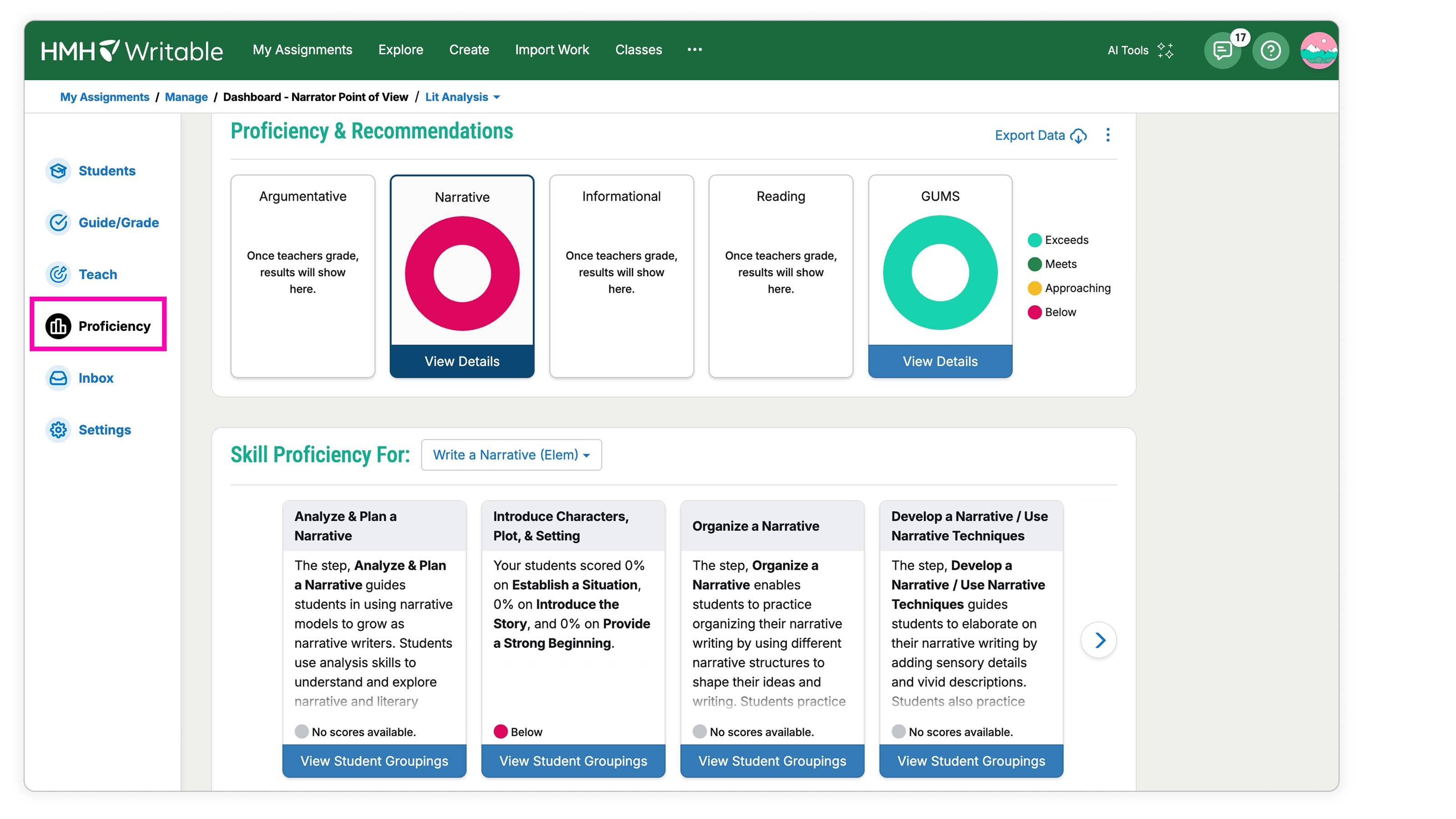
Writable’s dashboards give administrators a clear, at-a-glance view of writing development across classrooms. For example, a principal, alongside a curriculum specialist or instructional coach, might notice that school-wide students are consistently struggling with elaboration or organization. This insight can guide upcoming professional learning community (PLC) conversations or inform targeted professional learning. As students complete assignments throughout the year, growth reports help leaders celebrate progress and identify where additional support may be needed.
Supporting teacher feedback and student growth
Teachers know that giving thoughtful, timely feedback is one of the most powerful ways to help students grow as writers and can also be one of the hardest to sustain during a busy school day. Students hand you drafts full of potential, and you want to give each one the attention it deserves. But between conferences, small groups, and everything else on your plate, meaningful and timely feedback can be challenging to deliver consistently.
Writable’s AI-powered feedback gives students immediate, actionable suggestions to improve their writing. Teachers can add their own guidance, choosing from multiple levels of support that match the expectations in Into Reading and Into Literature.
This constant feedback loop transformed the classroom dynamic. Students were more engaged and productive. “I feel like everyone’s productive because they have the ability to get in the moment feedback through Writable in a variety of ways,” Behnke observed. The writing process became quicker, more interactive, and less dependent on the teacher’s schedule. This allows the balance to shift teachers from being the only source of feedback to being strategic partners in students’ growth.
Helping administrators track progress
Administrators want to know how students are growing as writers and not just at the end of a quarter, but throughout the learning process. Writable also provides insights that help teachers and administrators monitor growth, adapt instruction, and support district goals.
Features like Authorship Alerts promote authentic writing, while dashboards and growth reports offer real-time data to guide instructional decisions. Administrators gain a clearer view of curriculum alignment, student progress, and professional learning needs.
Getting started: Practical advice from educators
For anyone exploring AI-powered writing support, the guidance from teachers is simple: start small and stay curious. Experiment and be open to the possibilities, especially as you begin a new school year. “If it’s just something small, like helping your students with brainstorming ideas, if it’s just generating some sentence stems, start there,” Behnke encouraged.
Try using Writable to generate prompts, scaffold assignments, or provide instant feedback. Embrace the messiness, maintain teacher autonomy, and remember that AI is a tool to enhance teaching, not replace it.
Supporting districtwide writing success
Writable for HMH Into Reading and HMH Into Literature gives teachers and administrators practical, everyday support. It gives teachers like Abbey Behnke and Michiela Miller time back and creates a clearer picture of writing growth across classrooms. With tools that generate prompts, scaffold assignments, provide instant AI-powered feedback, and track progress over time, Writable makes it easier to build strong writing habits and confident writers. It’s designed to strengthen the work you already do and make writing instruction more effective and inspiring for everyone.
***
HMH Into Reading has everything teachers need in one place to facilitate systematic and explicit whole- and small-group reading instruction.
Frequently asked questions
-
How can teachers tell whether Writable is improving student writing?
Writable is improving student writing when students demonstrate growth in idea development, organization, revision, and writing independence over time. Teachers can look for stronger writing samples, improved use of feedback, greater confidence during the writing process, and evidence that students are applying skills across multiple assignments.
-
Can Writable help students become more independent writers?
Writable can help students become more independent writers by providing structured guidance and opportunities to reflect on feedback throughout the writing process. As students develop stronger revision habits and greater ownership of their work, they may rely less on teacher prompts and more on their own decision-making.
-
How does Writable support college and career readiness?
Writable supports college and career readiness by helping students develop writing, communication, revision, and self-reflection skills that are valuable beyond the classroom. Regular opportunities to write, receive feedback, and improve their work can prepare students for future academic and professional expectations.
-
How can writing feedback support long-term student growth?
Writing feedback supports long-term student growth when students use it to improve future writing rather than only revising a single assignment. Consistent feedback can help students identify patterns, strengthen writing habits, and develop a deeper understanding of the skills that contribute to effective communication.
-
How can teachers balance technology and direct writing instruction?
Teachers can balance technology and direct writing instruction by using digital tools to support feedback, practice, and progress monitoring while continuing to model writing, facilitate discussion, and provide targeted instruction. Technology works most effectively when it complements, rather than replaces, strong teaching practices.
Save time on writing instruction and feedback with Writable.