







In 1776, American colonists signed the Declaration of Independence, shaping the course of the nation’s early history. The year 2026 marks a monumental occasion: the 250th anniversary of American independence.
This historic occasion is the perfect opportunity for students to learn about one of the most influential documents in U.S. history and explore its lasting impact. Bring history to your classroom with these fun Declaration of Independence activity and lesson plan ideas.
Teacher note: It is important to explain that some of the language used in the Declaration of Independence is not inclusive and does not reflect modern understanding of equality.
Declaration of Independence lesson plans
The following Declaration of Independence lesson plans help students explore the ideas, language, and historical context behind this foundational document.
1. Analyze the Declaration of Independence lesson (Grades 6–11)
At 1,337 words long, the Declaration of Independence is a relatively short document, yet it has had a lasting impact 250 years later. This lesson gives students an opportunity to deepen their understanding of this foundational text while practicing literacy skills.
Before you begin, briefly review what it means to paraphrase, which is restating ideas in clearer language without changing the meaning. When students put text in their own words, they demonstrate understanding and can more easily recall and reference key ideas as they discuss the text.
Give students time to analyze the Declaration individually or with a partner. For multilingual learners and striving readers you can pre-teach key vocabulary or provide line breaks and a chunk box around each sentence to make the text more accessible.
The process may look like:
- Read once straight through. The goal of this first read is to get a general sense of the text and ask big picture ideas such as: “What is this about?” and “What is the purpose of this text?”
- Reread while pausing and marking key ideas and unfamiliar words or concepts. Consider questions such as, “What claim is being made here?” and “What reasons or explanations are given to support that claim?”
- Rephrase key sentences or phrases. This may include replacing complex words with simpler ones or breaking long sentences into shorter ones.
- Compare the paraphrase with the original by asking questions like “Did I keep the original meaning?” and “Did I add anything that wasn’t there?”
Once students have finished reviewing the Declaration, bring the class together to discuss its meaning and significance. During the discussion, students can draw on their annotations and paraphrased notes to support and explain their interpretations.
As an extension, you can invite students to examine the contradiction between the Declaration’s claim that “all men are created equal” and the reality that many groups (for example, people who aren’t men) were denied rights and freedom at the time it was written. Ask students to analyze how this tension shapes our understanding of the document’s purpose and legacy, and to consider how founding ideals can both inspire change and reveal the limits of the historical moment in which they were written.
2. Path to independence: Timeline lesson (Grades 3–6)
The path to independence was shaped by a series of important events that unfolded over many years. To fully understand why colonists signed the Declaration of Independence, students first need to explore the events and decisions that came before it.
This events leading to the Declaration of Independence lesson plan encourages students to examine cause and effect and learn how specific actions and events led to growing tensions and, ultimately, the decision to declare independence.
Divide students into groups and assign each group a different event to research. Each group should write 1–2 sentences describing their event, including the cause (why something happened) and the effect (what happened as a result). Sentence frames may look like: “This event happened because ____. As a result, ____.”
Here’s an example of what one entry might look like:
1765 Stamp Act: British taxed colonists for printed materials such as newspapers and legal documents. Colonists argued that “taxation without representation” was unfair.
(Cause) The British wanted money to help pay for the French and Indian War.
(Effect) This led to protest and organized resistance, which increased colonial unity.
Here is a suggested timeline (adjust to match your curriculum if needed):
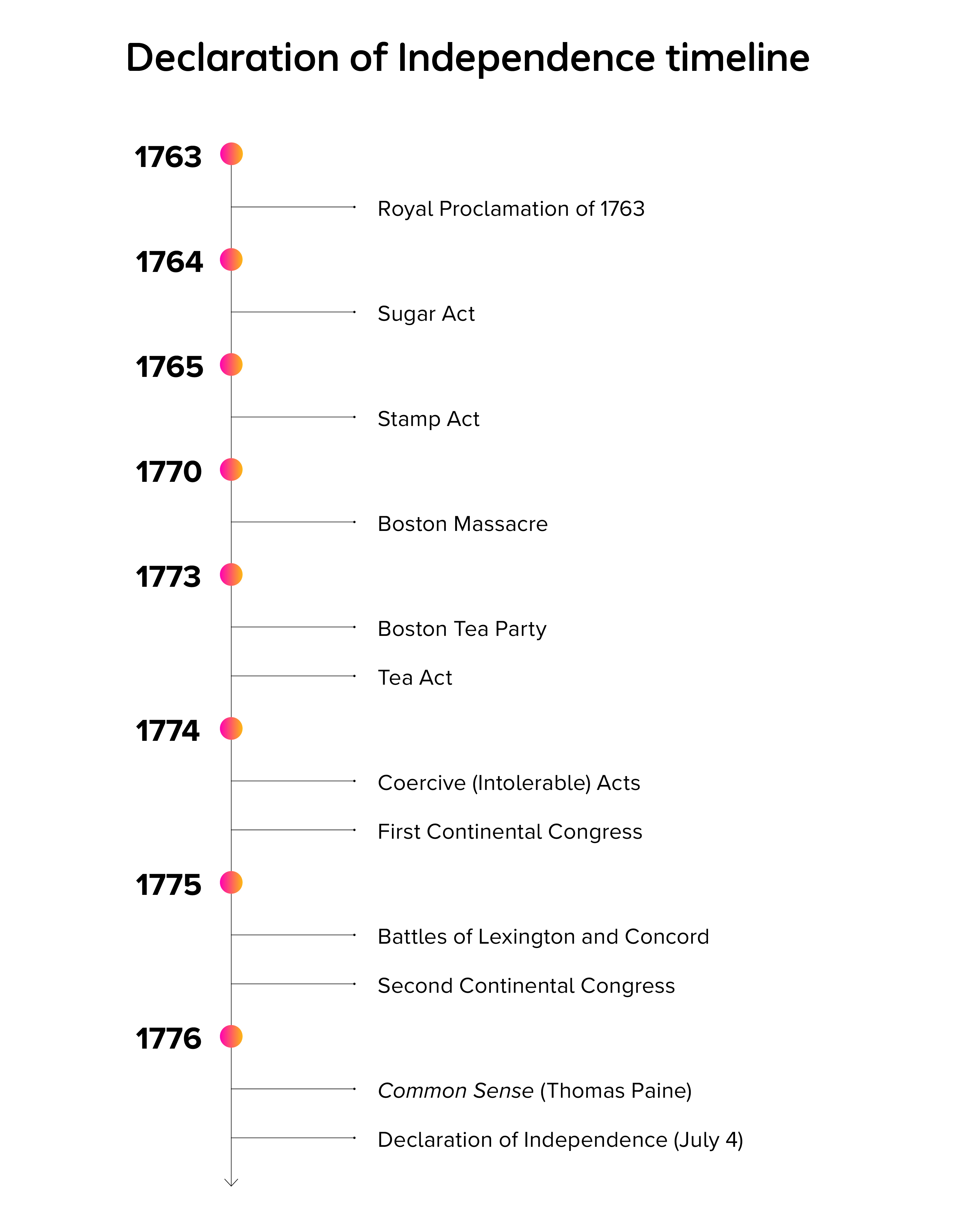
After students have finished researching their event, have the class come back together and make one timeline. As each group presents their findings, students can use this timeline graphic organizer template to take notes. You can ask discussion questions such as: What patterns or themes do you notice across the events on the timeline? Which event do you think had the greatest influence on the decision to declare independence? Explain your reasoning.
Download our FREE Substitute Teacher Activities pack
3. Declaration of Independence vocabulary lesson (Grades 4–8)
The Declaration of Independence is full of dense language and terms, many of which may be unfamiliar to students. This Declaration of Independence vocabulary lesson activity will give students a chance to dig deeper into the language used and the impact it had.
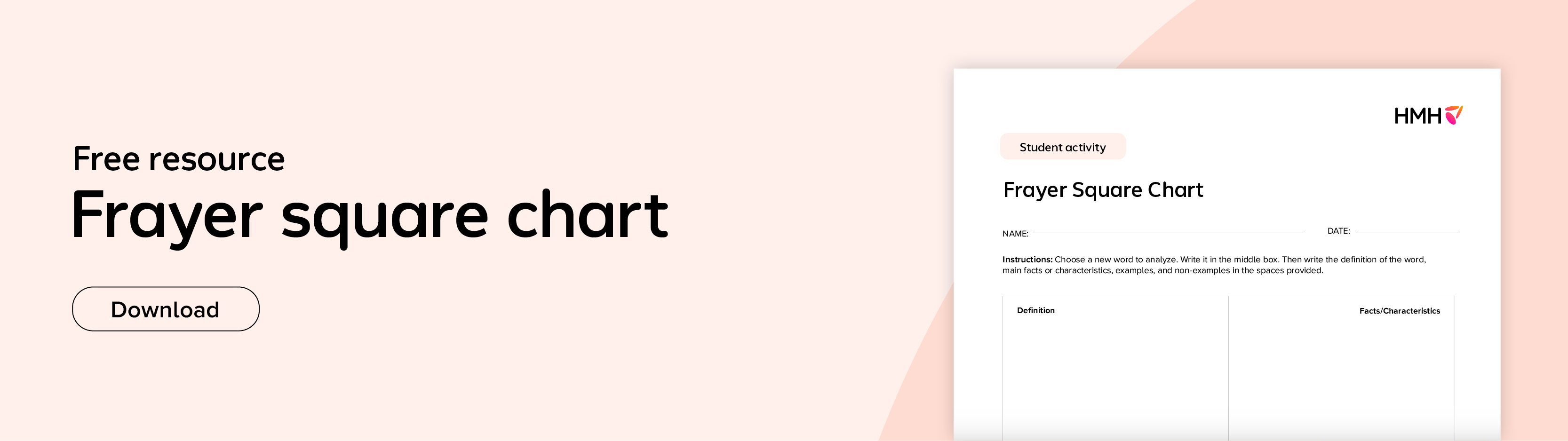
Students will use the Frayer square chart to define the word, give characteristics of the word, and list examples and non-examples. Download our Frayer square chart template to use with your students.
Before students begin, model what completing a Frayer chart looks like. For example:
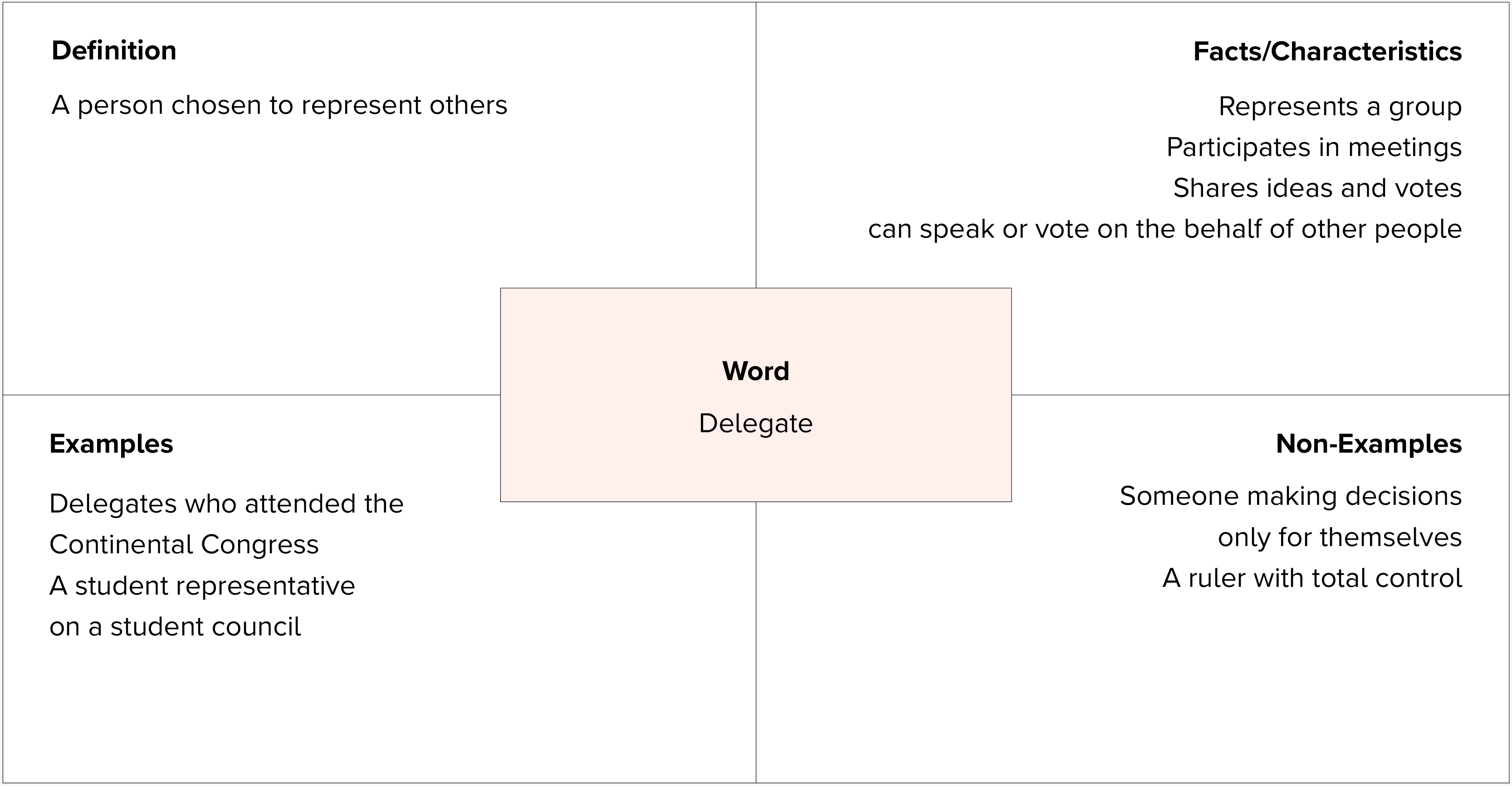
Here is a list of vocabulary words and phrases you might encounter in the Declaration. You can adjust the words to match your curriculum if needed.
- Declaration
- Independence
- Liberty
- Pursuit of Happiness
- Unalienable Rights
- Second Continental Congress
- Grievances
- Tyrant
Students can work independently or in pairs. Assign words so that more than one student or group is responsible for the same word. When they have finished, discuss as a class how students defined these terms. Were there any differences in definitions? Did students come up with modern examples of the words or phrases?
4. Declaration of Independence point of view lesson (Grades 6–11)
It’s 1776. Word has spread that the Declaration of Independence has been approved by the Second Continental Congress. People from all over are reacting, whether they agree or disagree with this proclamation. Let’s explore the different reactions and perspectives in this crucial moment in American history.
In small groups, have students create a short series of narrated video statements representing how different groups may have reacted to the Declaration’s announcement. These statements should be grounded in historical evidence, including primary sources, documented accounts, or well-established interpretations.
Some important viewpoints to consider are:
- Patriots: Those who fought for the ideals of liberty, individual rights, and self-government.
- Loyalists: Those who remained loyal to Britain and King George III.
- Neutralist: Those who decided not to pick sides. Some were pacifists, such as the Quakers, who wanted to avoid war.
After students have made their videos, have them explain why each group reacted the way they did. Did the Declaration of Independence unite people or deepen divisions?
As an extension, ask students to consider additional voices that were not included. They could discuss the roles and perspectives of women, enslaved African Americans, Native Americans, the British, and other European powers.
5. Declaration of Independence debate lesson (Grades 7–11)
The first shots of the American Revolutionary War, famously known as the “shot heard round the world,” happened at Lexington and Concord in 1775, over a year before the Declaration of Independence was signed. Even though tensions had escalated, many still believed that they could reconcile with England.
In the first poll taken during the Second Continental Congress, only seven of the 13 colonies supported independence. The delegates created the Committee of Five, led by Thomas Jefferson, to write a rationale that would persuade the remaining six. This was one of the most important debates in American history and now students can recreate it.
- Begin this activity by reviewing the situation in 1776. Students should consider the colonies’ relationship with Great Britain and the growing disagreements over rights, representation, and governance. It’s important to note that declaring independence was a major decision, and not everyone agreed that it was the best path forward.
- Once students are familiar with the times, pose the guiding question: Should the American colonies declare independence from Great Britain?
- Divide students into groups and assign each one a perspective: Patriots (support independence) or Loyalists (prefer to remain connected to Britain).
- Once students are assigned, have them work with their group to identify key reasons for supporting their position. Graphic organizers like Venn diagrams and T-charts can help students organize their ideas.
- Hold a guided debate. This works best when you have a clear structure and discussion rules. For example, each group takes turns sharing their viewpoints and responding to one another using evidence. It’s important for students to listen respectfully and remember that the purpose of this activity is to better understand the discussions leading up to the Declaration.
- After the discussion, have students reflect on the activity. Which perspective made the strongest case, and why? How does the Declaration of Independence reflect careful reasoning, not just emotion?
6. Write your own Declaration of Independence (Grades 4–8)
Just like the authors of the Declaration of Independence worked together to express shared values and make their case to the world, students will collaborate to create a Classroom Declaration that reflects what matters in their learning community. In this write your own Declaration of Independence lesson plan, students will draw inspiration from the structure and purpose of the original document to clearly articulate shared beliefs, expectations, and commitments.
As a whole group or in small groups, draft each section. You can chart responses or use shared digital tools to collaborate. When you are drafting, consider:
- Purpose: Why does this classroom exist? What is the goal of learning together? Example: “We, the students of Room ____, believe our classroom should be a place where. . . .”
- Shared values: What helps everyone learn? How do we want people to feel here? Think about values like respect, curiosity, effort, kindness, and collaboration.
- Rights and responsibilities: What rights do students need in order to learn? What responsibilities help protect those rights? Example: The right to be heard. The responsibility to listen to others.
Read the full declaration aloud together and make revisions. If needed, you can have students vote on final language to ensure that everyone’s voices are heard.
Once all revisions have been made, create a final version on chart paper or a poster. Each student should sign their name. Afterwards, students can write a brief reflection that answers this question: What part of our declaration matters most to you?
Declaration of Independence activities
Unlike the previous lesson plans, these Declaration of Independence activities are quicker and can fit into a longer lesson plan. They give students interactive ways to explore the document’s ideas and language through discussion, collaboration, and active engagement.
7. Declaration of Independence break up letter activity (Grades 6–11)
The Declaration of Independence was the American colonies’ way of formally ending their political relationship with Great Britain. They explained what they believed, their ongoing concerns, and why they were choosing independence.
For this creative writing activity, students will write their own letter from the colonies’ point of view. Their letter should:
- Explain the reasons for declaring independence
- Clearly state the colonies’ core beliefs and values
- Describe at least three issues or grievances that influenced their decision
- End with a firm but respectful statement of independence
Students can borrow ideas and tone from the Declaration of Independence but should use modern or conversational language in their letter.
8. Signers of the Declaration: A jigsaw activity (Grades 5–9)
John Hancock is perhaps the most famous signer of the Declaration of Independence. His large and distinctive signature became so memorable that his name is now sometimes used to mean a person’s signature. But there were 56 people who signed the Declaration of Independence, and many of them are remembered as important figures in American history. This activity takes a closer look at the individuals who took the first step to America’s independence.
The jigsaw method is a learning strategy where students become experts on one part of a larger topic and then teach what they learned to their peers. Here’s how it works:
- Divide students into small groups of 3–5. This will be the “home” group where each member is assigned a different subtopic. In this case, each student will have a different signer to learn about. Select a few signers to focus on so that multiple students are researching the same people. Don’t worry about covering all 56 signers during this activity.
- After the signers are assigned, students will then move into “expert” groups with classmates who are researching the same signer. Each expert group will work together to learn about their signer. Students may consider the colony or state the signer represented, their role in the Revolution, notable accomplishments or contributions, famous quotes, interesting facts, and personal details like their birthdate, death date, and age they lived to. There are lots of great resources you can recommend as a starting point, such as the National Archives or the Smithsonian.
- Before expert groups break apart, check in to ensure students have an accurate understanding of their signer and address any misconceptions. This helps ensure that accurate information is shared during the next step.
- Students return to their home group and take turns teaching their peers about their signer. As each student shares, the group will be able to piece together a broader picture of the signers of the Declaration and why each individual mattered.
- After all students have shared what they learned, have each home group work on a collaborative task, such as a poster, presentation, or graphic organizer. This step offers students an opportunity to put all that they have learned together and see connections across the different signers.
- To wrap up this activity, ask students to complete an individual task, such as an exit ticket, short written reflection, or quiz. This helps assess each student’s understanding of the full lesson, not just their assigned signer.

As an alternative to the jigsaw strategy, students can individually research different signers of the Declaration of Independence, with each student assigned a unique signer that no one else in the class studies. With this approach students will become the sole expert on their signer and can share their findings through short presentations or gallery walks. This option works well if you want the class to explore a wide range of signers and the variety of backgrounds and roles that shaped the Declaration, while the jigsaw method is more effective for deeper exploration of a smaller, carefully chosen group.
9. Declaration of Independence grievance sorting activity (Grades 6–9)
The Declaration of Independence lists 27 specific grievances against King George III. In this activity, students will learn about the significance of each of these grievances and see patterns in colonial complaints.
- Provide students with the list of grievances. Depending on the grade level, you could have students read the Declaration and pull directly from the source material or you could use a resource that explains the grievances. The National Park Service has a great resource that looks at each grievance and gives additional context.
- Students write each grievance on a flash card. As students work, make sure to answer any questions they have. Help them understand what each grievance means for the next step.
- Students should sort the grievances into categories. For example: limits on self-government, unfair laws or taxes, abuse of power, and military control.
- Once students have sorted the grievances, they should explain why they put them in each category. This can be a discussion as a whole group or in small groups. Ask students: What kinds of problems came up again and again? Were there any grievances that seemed to fit into more than one category?
10. Conduct an interview (Grades 4–8)
The Declaration of Independence states that people are entitled to Life, Liberty and the Pursuit of Happiness. Have students interview a member of their family or community about this ideal. Start with these questions and encourage students to add others that are meaningful to them.
- What does it mean to you that all people have the right to live?
- What does it mean to you that all people have the right to liberty?
- What does it mean to you that all people have the right to pursue happiness?
- What do you hope “Life, Liberty and the Pursuit of Happiness” will mean for future generations?
Students can ask their interview subject if they can record. If they agree, students can share their recording with the class or, if they don’t want to be recorded, students can share their findings in a presentation.
More ideas for teaching the Declaration of Independence
Do you have any activities for teaching the Declaration of Independence? We’d love to hear your ideas for Declaration of Independence lesson plans. Share them with us via email at shaped@hmhco.com.
***
Find more lesson plans and classroom resources on Shaped.